
Technology
The Silicone Wall and the Old First Empires
Christopher Columbus and Gonzalo Fernández de Oviedo y Valdés participated in the Spanish colonisation of the West Indies. Both were impressed by the size of the canoes made from the silk cotton tree.
Christopher Columbus and Gonzalo Fernández de Oviedo y Valdés participated in the Spanish colonisation of the West Indies. Both were impressed by the size of the canoes made from the silk cotton tree. The canoes were hollowed out of tree trunks in one piece; some could carry more than one hundred men. The Taino and Kalinago used the silk cotton tree for canoe making and believed that the tree was home to spirits.
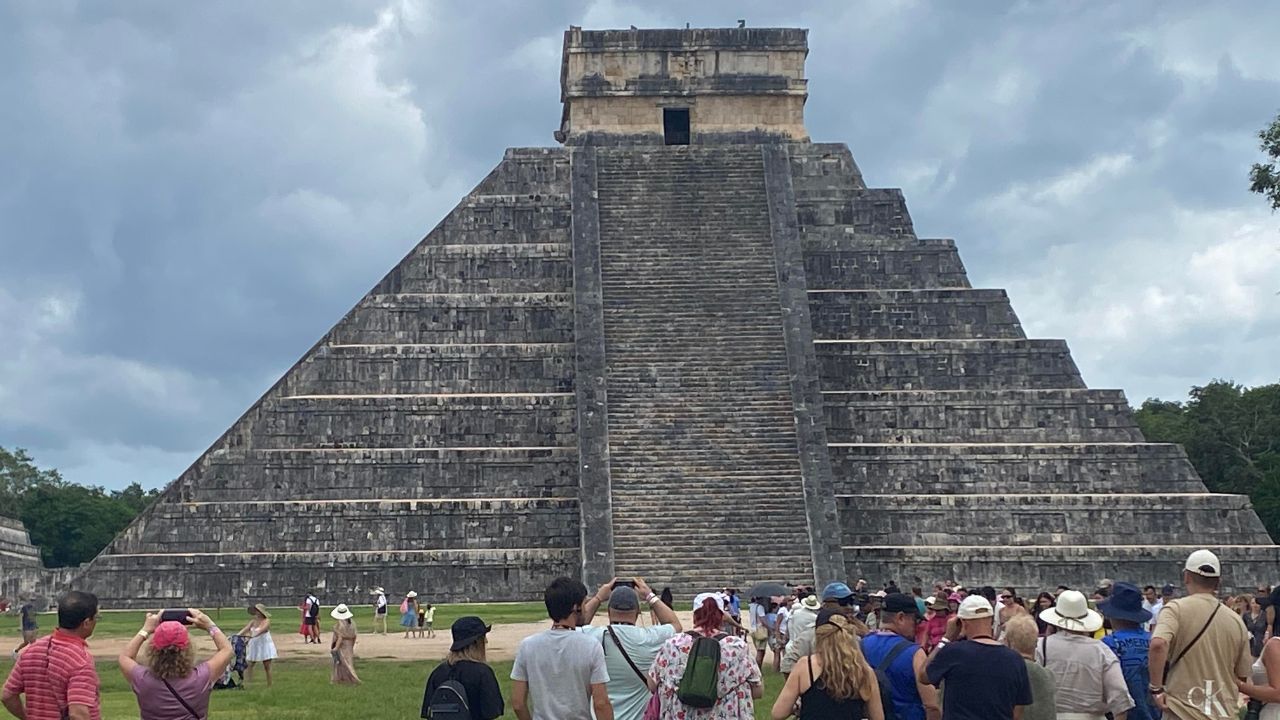
The kapok or silk-cotton tree was also symbolic to the ancient Mayans. The Mayans called it Yax Che, or “First Tree”. It was considered a route across three levels of existence. Its roots dwelled in the dark underworld. The trunk was the middle world where the humans lived, and its green canopy of branches reached into the upper world of thirteen levels of the Mayan heaven.
The Mayan Empire peaked around the sixth century A.D. They excelled at calendar-making, mathematics, architecture, and symbolic artwork. The Mayan civilization was one of the most dominant societies before the 16th-century Spanish conquest.
In the sixteenth century, when Spanish, Dutch, and Portuguese conquistadores were building the First Empires, they arrived on ships with sails. When the British, Russians, and Japanese made their bids for supremacy in the nineteenth and twentieth centuries, they relied on steamships and locomotives. In the twenty-first century, sending galleons with cannons, or German U-boats with deck guns and torpedoes is unnecessary. You only need to mine and refine the data to dominate a colony. Many people will be living in independent countries that are Republics which may become Data Colonies unbeknownst to them.
Data Colonialism happens when a country finds itself utterly dependent on digital infrastructures and AI-powered systems over which it has no effective control. Data colonialism can ultimately spiral into social credit systems that harvest data anywhere. Colonies of former industrial powers like Belgium and Britain provided raw materials, while state-of-the-art technologies and factories remained in the imperial hub. Egypt exported cotton and imported textiles. Malaya provided rubber for car tyres. The cars were made in Coventry.
The British Empire could concentrate industrial production in its home islands, extract raw materials from plantations in the West Indies, India, Egypt, and Iraq, and export finished goods manufactured in Belfast or Birmingham. What limited the over-concentration of wealth and power was physical science and geology.
Oil wells in Trinidad and Kirkuk could not be relocated to Yorkshire. Cotton mills could not be moved from Calcutta to Manchester. But data can. From 1733 to 1765 the first weaving machine to use steel combs replaced the early wooden combs. Bombay Dockyard started by the East India Company (EIC) built ships for both the Company and the Royal Navy. The EIC registered its first manufacturing works in Surat. The end of the 19th century to the 20th century marked the second Dark Age for shipbuilding in India. Despite industrial advances, British shipbuilders declined to transfer new shipbuilding technologies to India.
For AI to design Carnival Bands like those in Trinidad and Tobago, it needs images of costumes made by Peter Minshall, George Bailey, Wayne Berkley, and Stephen Lee Heung. To produce the trendiest fashion collections, AI needs images from the collections of Fe Noel, Maximilian Davis, Brandon Blackwood, and Krystal Paniagua. To provide healthcare, AI needs data on genes and clinical conditions. Autonomous vehicles need data about traffic patterns. In the age of AI, these are the new economic assets.
During the Industrial Revolution machines displaced landownership as prime. Power stations, fuelling stations, bridges, industrial hubs, railroads, sea and airports that mirror the Old Silk Roads, white gold mines in Zimbabwe, and cobalt and copper mines in the Democratic Republic of the Congo were until recently the most valuable classes of assets.
However, the AI revolution is not unlike the Industrial Revolution. The transatlantic slave trade enlarged the pool of investable funds and produced a trade pattern that fostered industrialization in Europe. The potential geopolitical impact was underestimated by governments. In 1830 the first commercial railway between Liverpool and Manchester was funded by a private company. The need for fresh markets and raw materials justified imperialism as railroads played a huge role in the American Expansion Westwards and the Russian Expansion Eastwards.
The world is made up of just under 200 nations. Many became independent in 1945. In addition to dictatorial AI, new AI chip architectures make it easier to store and process information in a central hub that ushers humanity into a new imperial era. A few or perhaps one empire may emerge that mirrors the grip of the old Russian or British empires. With the dawn of cheap radio sets the technology was the same in East and West Germany. However, politics made very different uses of it on each side of the Berlin Wall.
In a multipolar AI world, humanity may be divided along a Silicon Curtain as regions like Latin America and the Caribbean choose their unique answers to the alignment problem, or other technological difficulties and dilemmas. Alternatively, each may attempt to build indigenous networks that respond to the prejudgements and prejudices of the Enlightenment, and the futures they wish to create.
, Fazal Ali · 01 November 2024 -
Next entry · Technology
AI and the New Inorganic Networks
Future pull requires divine determination. Reality is limited. In the infosphere, we need perpetual daydreaming and the flow of grace. We must know our place in the future. Fear must depart leaving only delight behind.